Dog De-Matting in Maryville, TN
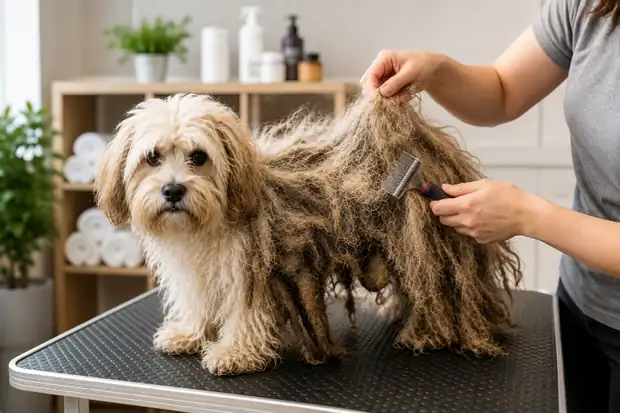
Most mats aren’t found on purpose — they’re discovered during a bath, a pat down the leg, or a routine groom, usually behind the ears or under the legs, already tight against the skin.
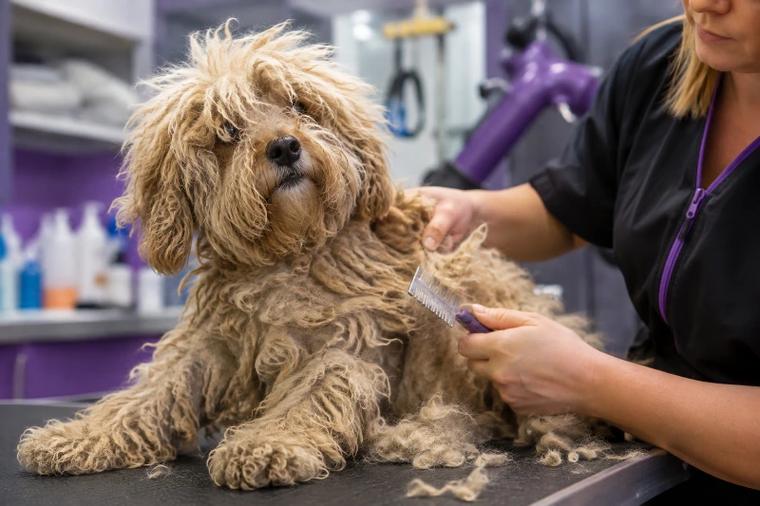
De-matting is the process of carefully working out tangled, compacted fur without unnecessary pain or unnecessary shaving. Sometimes that’s fully possible. Sometimes, depending on how close the mat sits to the skin, a partial or full shave is genuinely the safer option — and a big part of doing this well is being honest with you about which situation you’re actually in before we start.
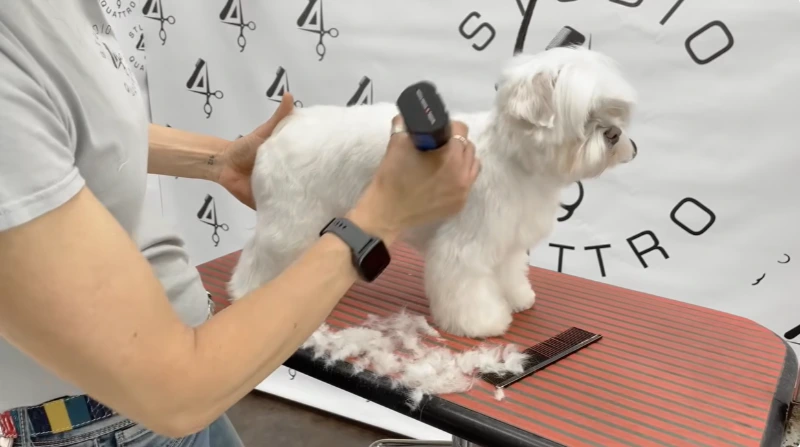
Think Your Dog Might Have a Mat Like This?
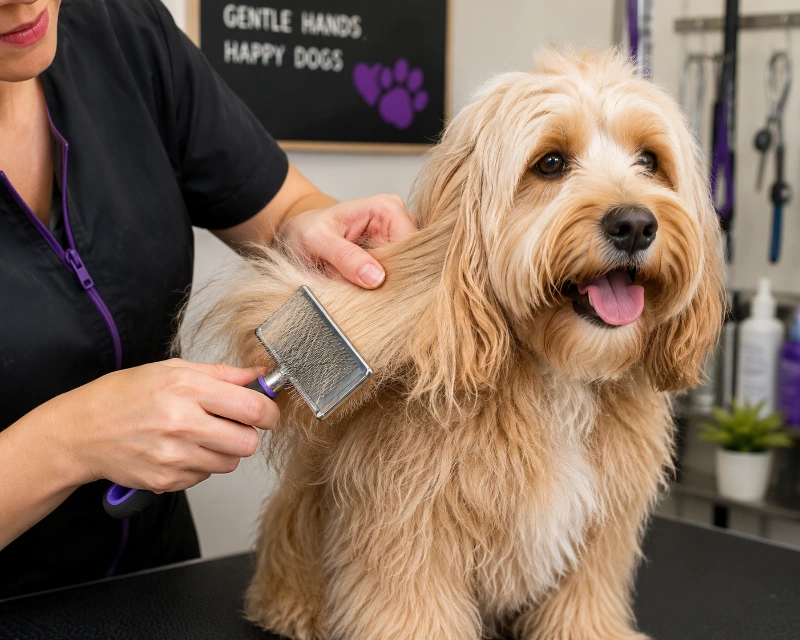
What Causes Matting in the First Place?
Matting happens when loose, shed fur doesn’t fall away and instead tangles with the surrounding coat, usually because of moisture, friction, or a coat that’s gone too long without a brush-out. Humidity is one of the most common accelerators — a coat that stays damp longer holds onto loose fur instead of shedding it cleanly, which is part of why matting tends to move faster in wetter climates and wetter seasons than in dry ones. Areas with more movement and less airflow — behind the ears, under the collar, in the armpits, around the tail — mat first and worst, because that’s where friction and trapped moisture do the most damage.
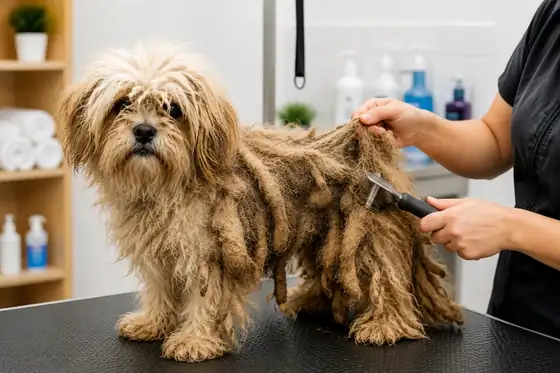
Double-coated and curly-coated breeds are more prone to it structurally, since their undercoat is built to trap loose fur rather than shed it cleanly. In severe, long-neglected cases, matting can progress into what’s known as “pelting” — large sections of the coat fusing into a single dense mass, similar to felt. Pelted fur is a different level of problem entirely and almost always requires clipping rather than combing, simply because there’s no safe way to separate it from the skin by hand.
Maryville’s own climate plays a role here too. Humidity that regularly sits above national averages, combined with mud from local trails and yards, means coats here often hold onto moisture longer than they would in a drier region — which is a big part of why matting tends to move faster for dogs in and around Blount County than owners moving here from elsewhere often expect.
How Can You Tell If a Mat Needs Professional Attention?
A loose tangle that a brush or comb works through without resistance usually isn’t a problem — that’s normal maintenance, not a mat that needs professional de-matting. The mats that need real attention are the ones that don’t give when you gently try to work through them, or that sit close enough to the skin that you can feel tension when your dog moves. If a mat is pulling at the skin, if your dog flinches when you touch a specific spot, or if you can see skin irritation, redness, or an odor near a matted area, that’s no longer a brushing problem — it’s worth having a professional look at it, both for the coat and to check the skin underneath.
What Actually Happens During a De-Matting Appointment
We start by assessing the mat, not cutting into it. That means checking how close it sits to the skin, how large an area is affected, and whether it’s isolated or spread across the coat. This assessment is what determines the approach — and it’s also the point where we talk to you honestly about what’s realistic.
If the mat has room to work with
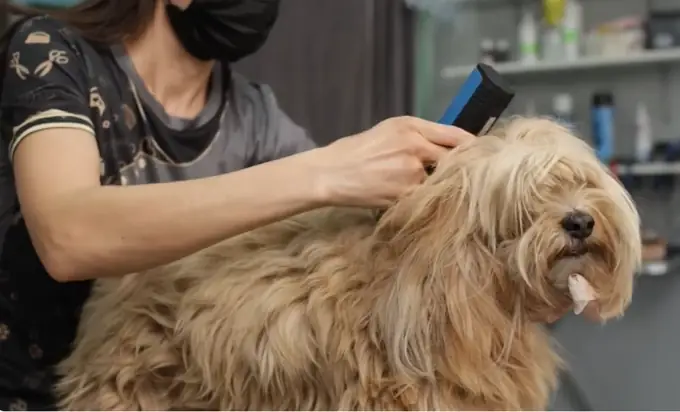
We use detangling tools and technique to carefully separate it from the coat, in sections, checking the skin underneath as we go. This takes patience and time, and we pace it to what your dog can tolerate — stopping for breaks, never forcing through resistance.
If the mat is too tight against the skin to safely comb out
Attempting to pull or cut it loose risks cutting the skin itself, since matted fur that close to the body doesn’t leave a safe margin. In that case, clipping the mat out — sometimes just that section, sometimes more if matting is widespread — is the safer choice, even though it’s not always the outcome an owner was hoping for. We won’t make that call without explaining why first.
Throughout either approach, your dog is never left restrained and unattended, and we stop if a dog is showing real distress rather than pushing through.
Will De-Matting Hurt My Dog?
A mild tangle worked out with the right technique generally isn’t painful. A mat that’s tight against the skin is a different story — pulling on it does hurt, which is exactly why forcing a comb through a severe mat isn’t the safer option, even though it might seem like the less drastic one. This is the real reason experienced groomers often recommend clipping a bad mat out rather than fighting it loose: a few minutes of careful clipping is usually far less distressing for a dog than a long, painful de-matting session that fights the coat the entire way through.
The honest answer, not a shortcut
If you’ve been told your dog “needs to be shaved” because of matting, that’s often the honest, kinder answer.
Can Matting Be Prevented, or Is It Just Something That Happens?
Prevention comes down to two things: regular brushing between grooms, and staying ahead of your dog’s natural grooming interval rather than falling behind it. A quick brush-out two or three times a week, focused on the areas that mat first (behind the ears, under the legs, around the tail), catches loose fur before it has time to tangle. Fully drying your dog after a bath or a walk in wet weather matters too — a damp undercoat left to air-dry is one of the most common, and most avoidable, causes of matting between appointments.
For dogs prone to matting, more frequent maintenance visits (bath & nails or a full groom on a shorter interval) usually cost less over time than repeated de-matting sessions, and they’re considerably easier on the dog.
Is De-Matting More Expensive Than a Regular Groom?
De-matting takes real additional time and sometimes a different approach than a standard groom, which is reflected in the price — but the exact cost depends entirely on the severity and extent of the matting, so it isn’t something we can quote with a flat number in advance. What we can promise is that we’ll assess the coat and give you a clear estimate before starting any work, and we’ll explain what’s driving that estimate rather than surprise you with a different number at pickup. Give us a call and we’ll walk you through our general service pricing.
Not Sure What Your Dog’s Coat Needs?
Call and describe what you’re seeing — we’ll tell you honestly what we’d recommend.
De-Matting vs. a Full Groom — What’s the Difference?
A full groom is routine maintenance — bath, cut, nails, and everything that comes with it, for a coat that’s in reasonably normal condition. De-matting is what happens when a coat has gone past that point and has tangles that need to be specifically addressed before (or instead of) a standard cut. In practice, de-matting is often paired with a full groom, since a mat-free coat still needs the rest of the standard service — but the de-matting itself is assessed and priced as its own piece of the visit, not folded invisibly into a flat groom price.
| Feature | Routine Full Groom | De-Matting |
|---|---|---|
| Starting Point | Coat in normal, maintained condition | Coat has tangled, compacted areas |
| Time Required | Standard groom time | Standard groom time, plus additional time for the matted areas |
| Approach | Bath, cut, nails, ears | Careful mat assessment first, then combing out or careful clipping as needed |
| Outcome | Full coat, styled | Mat-free coat — sometimes shorter than before if clipping was necessary |
What If My Dog Is Too Matted for a Bath First?
Sometimes, yes — a heavily matted coat can actually trap water against the skin during a bath, making things worse rather than better, and matted fur doesn’t clean properly no matter how long it’s washed. In cases like that, addressing the worst of the matting before bathing (rather than after) is often the right call, and we’ll explain that reasoning if it applies to your dog rather than just bathing on autopilot regardless of coat condition.
My Dog Was Recently Adopted and Is Already Matted — What Should I Expect?
This comes up often, and it’s handled differently than routine maintenance matting. A rescue or newly adopted dog with existing matting may also be dealing with an unfamiliar environment, an unfamiliar groomer, and unfamiliar handling all at once — so the priority for a first visit is usually patience over completeness. That can mean addressing the worst areas first and finishing the rest over a second appointment once your dog is more comfortable, rather than forcing one long session through a coat and a new relationship with a groomer at the same time.
If this is your situation, tell us when you book — it changes how we plan the visit. For a dog that’s especially anxious about car rides or unfamiliar spaces, our mobile grooming service is also worth asking about, since a first appointment at home can sometimes be an easier starting point than a studio visit.
How We Decide What’s Right for Your Dog’s Coat
There’s no universal rule for when to comb versus when to clip — it genuinely depends on the individual mat, the individual dog, and how much tolerance that dog has on that specific day. What we can commit to is the process behind the decision:
We check before we cut — the mat is assessed first, before any decision is made.
We explain what we’re seeing in plain terms, so the approach is never a surprise.
We stop if a dog is struggling rather than push through for the sake of finishing faster.
If we’re ever unsure whether a mat is safe to work through by hand, we treat it as though it isn’t — a cautious call is always the safer one for your dog.
Can I Try to De-Mat My Dog Myself First?
For loose tangles, yes — a slicker brush or metal comb, used gently and with patience, handles most everyday tangling just fine. For anything tight against the skin, we’d genuinely discourage it. Scissors are the biggest risk here: it’s easy to misjudge how much skin is bunched up inside a mat, and dog skin is thinner and looser than most people expect, especially around the legs and belly. If a mat doesn’t come loose with gentle brushing in a minute or two, that’s usually the point to stop and have it looked at rather than keep working at it.
How Long Does a De-Matting Appointment Take?
It depends entirely on how much matting there is and how your dog handles the process, so we’re cautious about giving a fixed number upfront. A few isolated mats might add a modest amount of time to a routine groom. A coat with widespread matting is a longer appointment, and we’d rather take the time it actually needs than rush it. We’ll give you a realistic estimate once we’ve assessed your dog in person.
If your dog has a mat you’re not sure what to do with, the safest next step is having it looked at rather than guessing — either brushing through something that shouldn’t be brushed, or worrying about something that’s actually manageable. Call and describe what you’re seeing, and we’ll tell you honestly what we’d recommend.
Frequently Asked Questions
What causes a dog’s coat to mat?
Matting happens when loose, shed fur tangles with the surrounding coat instead of falling away, often accelerated by moisture, friction, and going too long between grooms. Areas with less airflow — behind the ears, under the legs, around the tail — mat first.
How do I know if my dog’s mat needs professional help?
If a tangle doesn’t give when gently worked with a comb, pulls at the skin, or shows redness or irritation nearby, it’s worth having a professional look at it rather than continuing to brush it at home.
Does de-matting hurt dogs?
Mild tangles worked out with the right technique generally aren’t painful. Mats tight against the skin can be painful to comb out, which is often why clipping the mat out is the safer, kinder option rather than fighting it loose.
Will my dog need to be shaved for de-matting?
Sometimes, if a mat sits too close to the skin to safely comb out. We’ll always assess the mat and explain the reasoning before deciding on an approach, rather than defaulting to a shave without discussing it.
How much does de-matting cost?
Cost depends on the severity and extent of matting, so it isn’t quoted with a flat number in advance. We’ll assess the coat and provide a clear estimate before starting any work. Give us a call and we’ll walk you through our general service pricing.
Can matting be prevented?
Yes, largely through regular brushing between grooms and staying ahead of your dog’s natural grooming interval, along with fully drying the coat after baths or walks in wet weather.
Can I remove a mat myself at home?
Loose tangles often respond well to gentle brushing with a slicker brush or comb. Mats tight against the skin are best left to a professional — cutting with scissors near a mat carries real risk of cutting the skin underneath.
How long does de-matting take?
It depends on how much matting there is and how your dog tolerates the process. We give a realistic time estimate after assessing your dog in person rather than a fixed number upfront.